XRAI for Intelligent and Sustainable AEC: Survey on Integrating Extended Reality and Artificial Intelligence for Human-Centric Built Environments
May 16, 2026· ,,,,·
0 min read
,,,,·
0 min read
Prakash Naikade
Frederik Larsen
Mads Brath Jensen
Kasper T. Elmholdt
Andreas Møgelmose
Abstract
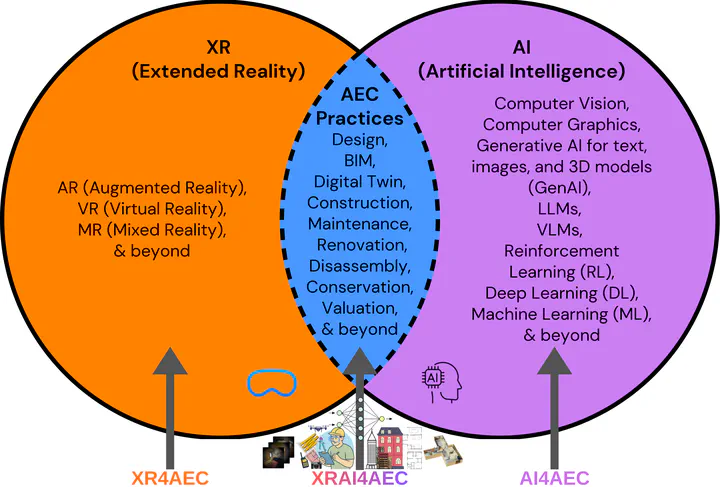
The Architecture, Engineering, and Construction (AEC) industry faces fundamental challenges driven by rapid construction of unsustainable built environments. In response, this survey examines the convergence of Extended Reality (XR) technologies, including Virtual Reality (VR), Augmented Reality (AR), and Mixed Reality (MR), with Artificial Intelligence (AI) methods such as 2D/3D Computer Vision, Large Language Models (LLMs), Vision-Language Models (VLMs), Generative AI (GenAI), and Machine Learning (ML), for sustainable AEC. Together, these technologies are fundamentally reshaping how buildings and spaces are designed, constructed, operated, and experienced. Drawing on interdisciplinary perspectives from XR, AI, AEC, and organizational science, we systematically review and structure the literature into six overarching research themes spanning entire building lifecycle. Our analysis reveals substantial progress in XR+AI-enabled workflows, alongside persistent challenges related to interpretability, interoperability, data governance, ethics, and socio-technical adoption. We further identify open research questions and underexplored opportunities at the intersection of XR, AI, and the built environment. By synthesizing fragmented advances across XR, AI, and AEC, this survey establishes a coherent conceptual and methodological foundation for future research and practice, offering a level of integrative coverage not achieved by prior surveys. It aims to guide researchers, practitioners, and policymakers in advancing integrated XRAI-driven AEC workflows toward more intelligent, sustainable, circular, and human-centered built environments across the full building lifecycle
Type
Publication
zenodo