AI-Driven Design and Generative Architecture
Instant Neural Graphics Primitives with a Multiresolution Hash Encoding
Abstract
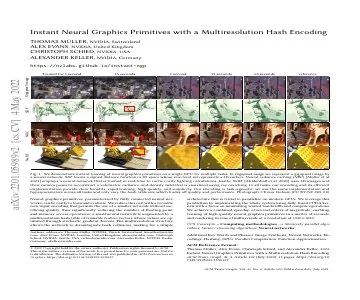
Neural graphics primitives, parameterized by fully connected neural networks, can be costly to train and evaluate. We reduce this cost with a versatile new input encoding that permits the use of a smaller network without sacrificing quality, thus significantly reducing the number of floating point and memory access operations: a small neural network is augmented by a multiresolution hash table of trainable feature vectors whose values are optimized through stochastic gradient descent. The multiresolution structure allows the network to disambiguate hash collisions, making for a simple architecture that is trivial to parallelize on modern GPUs. We leverage this parallelism by implementing the whole system using fully-fused CUDA kernels with a focus on minimizing wasted bandwidth and compute operations. We achieve a combined speedup of several orders of magnitude, enabling training of high-quality neural graphics primitives in a matter of seconds, and rendering in tens of milliseconds at a resolution of ${1920\!\times\!1080}$.
Topics
Cite this paper
@article{müller2022instant,
   title={Instant neural graphics primitives with a multiresolution hash encoding},
   volume={41},
   ISSN={1557-7368},
   url={http://dx.doi.org/10.1145/3528223.3530127},
   DOI={10.1145/3528223.3530127},
   number={4},
   journal={ACM Transactions on Graphics},
   publisher={Association for Computing Machinery (ACM)},
   author={Müller, Thomas and Evans, Alex and Schied, Christoph and Keller, Alexander},
   year={2022},
   month=jul, pages={1–15} }